
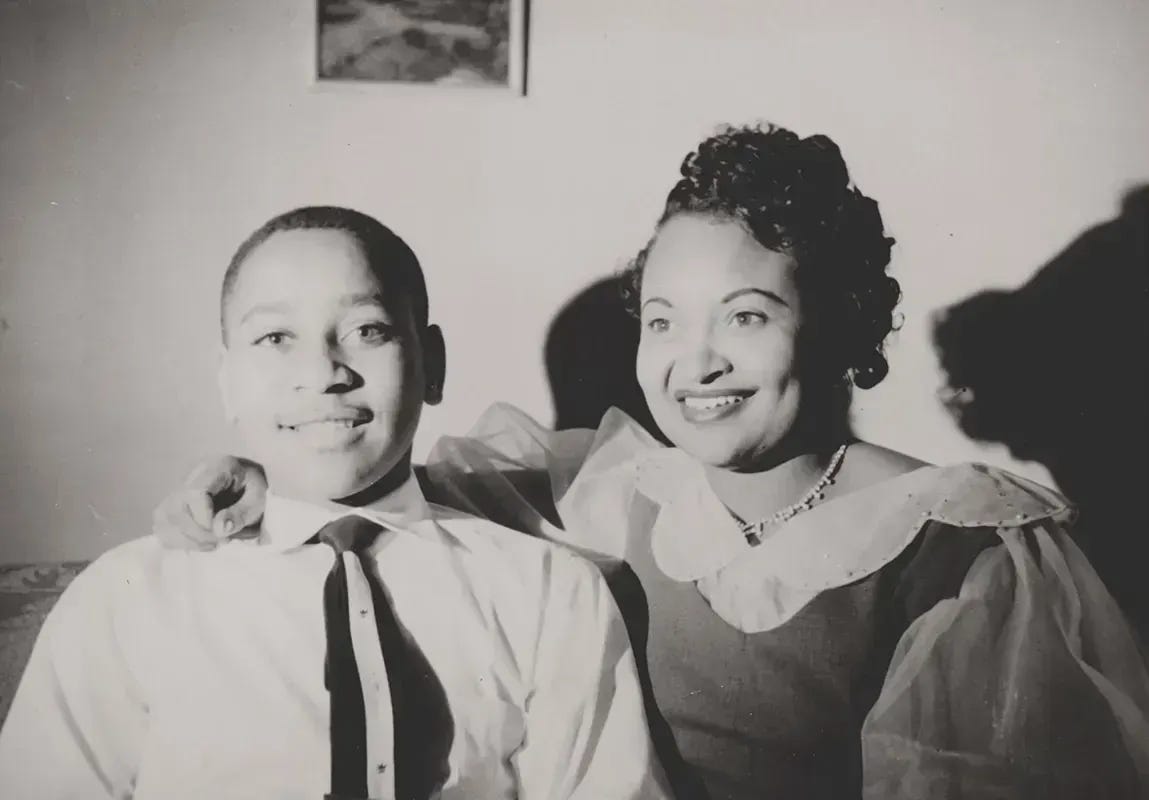
Mamie Carthan’s mother was strict. She kept her daughter on the straight and narrow, held her to account for every hour outside of school.
The family had come north when Mamie was just two years old, leaving Mississippi behind.
Every summer she went back. Steamy afternoons. Church picnics. An aunt who kept the South alive in her.
The Church of God in Christ was the center of everything in Argo, Illinois. Mamie loved poetry, and graduated at the top of her class.
In my day, the girls had one ambition: to get married, she recalled. Most did, by 16.
She waited, and went to work instead. For the Social Security Administration, then the U.S. Air Force.
At 18 she fell for Louis Till, a corn-plant worker who boxed on the side. Her parents disapproved.
He took her to an ice cream parlor for her first banana split. She married him.
Nine months later she had a son. She called him Bobo.
In 1945 a letter came from the War Department. Louis Till had been executed in Italy. Willful misconduct, they said.
She raised Bobo alone. He developed a stutter as a child. She taught him to whistle to help with it.
The summer of 1955 his cousins were heading to Mississippi. He wanted to go.
She said no. Many times.
How do you give a crash course in hatred to a boy who has only ever known love?
She relented. And put him on a southbound train.
When she made the announcement that her son had been found, the whole house began to scream and cry.
Mississippi authorities agreed to release the body on one condition: the casket stayed sealed. She refused. At the funeral home she told the director to leave her son exactly as she had found him. No cosmetics. No repair. No veil.
They would have to see their own responsibility, she later wrote.
Weeks later, a Mississippi senator leaked Louis Till’s Army file to the press. Willful misconduct meant a conviction for rape and murder.
Two months ago I had a nice apartment in Chicago, she said. I had a good job. I had a son. When something happened to the Negroes in the South I said, “That’s their business, not mine.” Now I know how wrong I was. The murder of my son has shown me that what happens to any of us, anywhere in the world, had better be the business of all of us.
She went back to school. Cum laude at Chicago Teachers College. Fifth in her class. Then a master’s. From Loyola.
She loved again, and married Gene Mobley in 1957.
She taught on Chicago’s South Side for twenty three years. She founded the Emmett Till Players. Children reciting speeches of hope, determination, unity.
She finished her memoir days before she died.
Although I have lived so much of my life without Emmett, she wrote, I have lived my entire life because of him.
Theme: “And Before I’d Be a Slave”
Date Published: Monday, July 13, 2026